

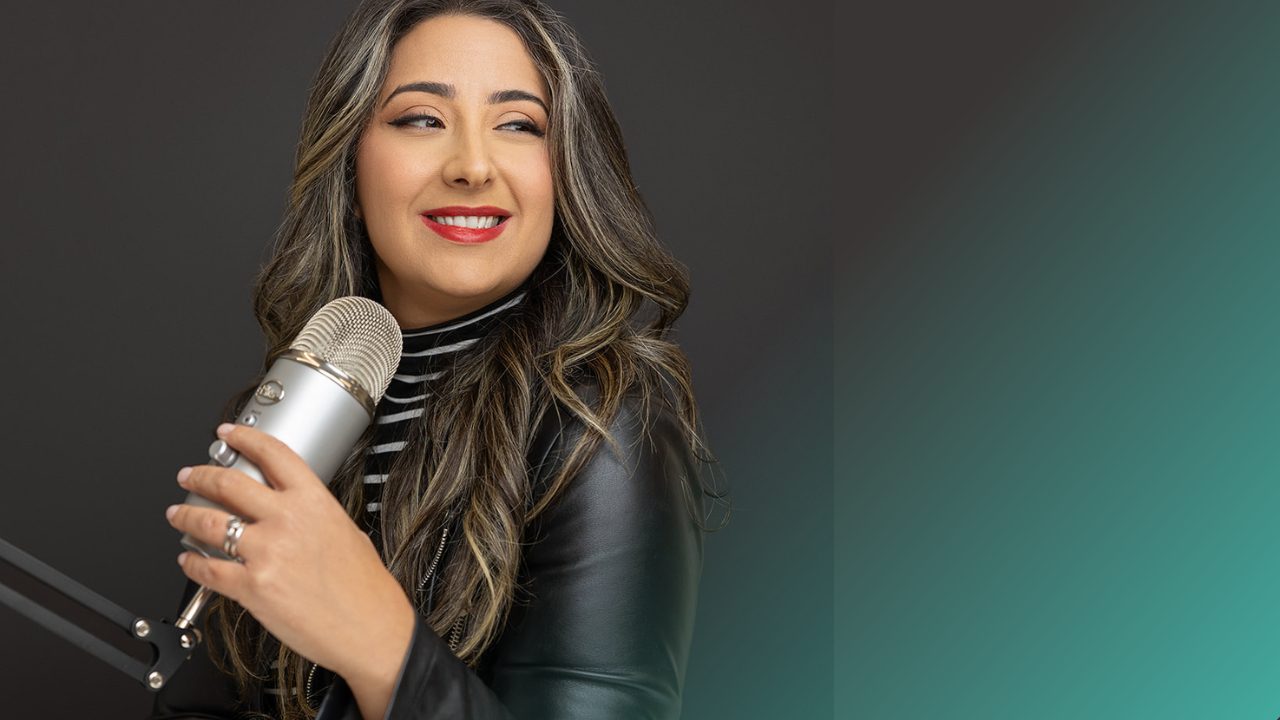
“What are some of your favorite ways to overcome self-doubt or being scared of taking a risk?”
This question came up during a private event Q&A while I was discussing the Lack of Confidence Overwhelm Culprit™ — and it hits home every single time.
So many high achievers hold themselves back from the exact move that would change everything. Not because they lack talent or vision. Because they’re afraid.
Here’s the truth: if you don’t take risks and do the things that make you uncomfortable, you’ll never grow. And if you don’t grow, nothing changes.
So if you’re wondering how to not be afraid to take risks – this post is for you. I’m sharing my biggest risk-taking story and the exact three-step framework I use to make calculated decisions, even when I’m terrified.
How to Not Be Afraid to Take Risks: My $20,000 Story
It was late 2019. I had been in business for about a year – funded by a six-month emergency savings account I called “the emergency of my soul.”
I was a newly divorced single mom of an infant with a mortgage. I had left a 15-year corporate career after losing a loved one to suicide and being the one to find him. I couldn’t afford to keep commuting 20 hours a week. I had to make my own path.
By the end of 2019, I was almost out of money. Burning through resources faster than I was generating revenue. And I was staring down the one thing I couldn’t stomach: getting another job.
Then I got on a discovery call with a coach I’d been following. He immediately saw exactly what was wrong and how to fix it. The price to work with him? $20,000.
Twenty thousand dollars I did not have. I was fully financially leveraged – no credit card debt, but almost no savings. Just a mortgage, a baby, and a business that wasn’t yet profitable.
I knew what I needed to do. I was just terrified to do it.
Here’s how I decided.
How to Not Be Afraid to Take Risks: The 3-Step Framework
Not every risk is worth taking. Even the best CEOs and founders know this. The goal isn’t to be fearless – it’s to be calculated. Here’s what that looks like in practice.
Step 1: Map Out the Best-Case Scenario
Most people think of pros as just “good things.” But I reframe them as: what does winning actually look like? What are the outcomes if I succeed?
For the $20,000 decision, here’s what I saw:
- I would learn how the personal development industry actually works. I was coming from electronics distribution – I had no idea how to package offers or price my services. This coach had been in it for years and knew what I didn’t know.
- I would be able to stay in business and become profitable – not just survive
- I would keep the freedom and flexibility that was the whole reason I left corporate in the first place. That freedom to be with my son – I had finally gotten it. Losing it was not an option.
- The ROI math actually worked. The coach was teaching high-ticket coaching. If I landed one to two clients, I could fully recoup my investment.
- For $20,000 I was getting a full year of one-on-one support – not a group program, not a course. Eyes on my specific situation, in a brand new industry, for twelve months.
When I looked at it that way, it stopped feeling like gambling and started feeling like an investment with a real potential return.
Step 2: Map Out the Worst-Case Scenario
I reframe cons as: what is the worst thing that happens if I fail? Not what could go wrong in theory – what is the actual worst-case scenario?
For me it looked like this:
- I’d have to get another job. Zero stars, do not recommend. But I had left a high-paying SVP role. I knew that option was available to me if I needed it.
- I’d likely have to commute again. Painful – but I had done it before and survived it. I could survive it again if I had to.
- I’d have a $20,000 credit card bill. But if I was back earning six figures, I’d have the means to pay it off.
- I’d have to explain to people why it didn’t work. But here’s the truth – nobody is watching that closely. People pay attention to what you accomplish. They don’t go looking for your failures. They’re worried about their own lives.
Going through this, I realized the cons weren’t really cons. They were Plan B. And having a Plan B makes a scary risk feel a whole lot more manageable.
Nine times out of ten, the worst case is nowhere near as devastating as you imagined. That realization alone is one of the most powerful tools for learning how to not be afraid to take risks.
Step 3: Listen to Your Intuition – Your Body Doesn’t Lie
Once the analytical work is done, go inward. Your intuition is that first feeling before your brain starts talking you out of it. And your body knows.
When something feels safe, your body feels safe. No tension. No heart palpitations. No knot in your stomach.
Here’s what my intuition was telling me with this investment:
- The coach had already demonstrated his skill set during the free strategy call – with zero pressure to buy. He even shut the call down when I got too emotional, asked me to take time, and rescheduled. That kind of integrity was a green light.
- There was no sales pressure. I was in complete control of my decision. We ended the call and scheduled a follow-up a few days later so I had time to think.
- His track record spoke for itself. The case studies and testimonials showed results with the exact type of clients I wanted to become.
- His assessment of my problem was 100% correct. He spotted something I was too deep in to see myself. If he could do that in one free call, a full year of that support was worth every penny.
Then came the moment of truth. I gave him my credit card number across two cards. The payment went through. He said “congratulations, we’re all set.”
I felt relieved. Not anxious. Not panicked. Relieved.
That’s the signal. Relief after a scary decision means your body is telling you something worth listening to.
What Happened – And Why Knowing How to Not Be Afraid to Take Risks Changed Everything
I made my money back in 12 weeks! The credit cards got paid off. I stayed in business. And now, in 2026, I’m six years in as a professional speaker and author.
None of it would have happened without that one decision. Not the speaking career. Not the book. Not the high-ticket sales skills that became the foundation of everything else. Not the confidence I didn’t even know I was missing.
The scariest investment of my life. The best decision I ever made.
You don’t need to fully believe in yourself before you take the leap. You just need a calculated plan and the willingness to listen when your gut says go.
Find Out If Lack of Confidence Is Your Overwhelm Culprit
If self-doubt is keeping you from the risks you know you need to take, confidence might be your missing piece. The free Overwhelm Culprit Quiz tells you in three minutes which of the five culprits is holding you back — and your most powerful next step to address it.
Take the free Overwhelm Culprit Quiz here.
Go Deeper With the Book
I cover the Lack of Confidence Overwhelm Culprit™ in full detail in my book — with even more strategies for building belief, taking calculated risks, and stepping fully into the leader you already are.
The Five Overwhelm Culprits™: Strategies to Save Your Sanity Without Sacrificing Your Success is available now everywhere books are sold.
This is the book for the high-performing woman who is done letting fear make her decisions.
CLICK FOR TRANSCRIPT
[00:00:00] What are some of your favorite ways to overcome self-doubt or being scared of taking a risk? This is a question I received during a recent private event Q&A while discussing the lack of confidence overwhelm culprit.
And I realized it’s such a great topic to cover here, since so many of the clients that I’ve worked with hold themselves back, and it’s rooted in fear of taking risks. But here’s the thing, if you don’t take risks and do the things that make you uncomfortable, you’ll never grow. And if you don’t grow, nothing will ever change.
If you’re a high achiever who’s debating taking a major risk that you know that you need to hit your next level, then you’re gonna wanna stick around. Because by the end of this episode, you’ll know exactly how to determine whether or not the risk is worth taking, as well as some simple strategies to feel more self-assured in doing whatever that big scary thing is.
If you’re new here, my name is Corrie LoGiudice, otherwise known as [00:01:00] Corrie Lo, and I’m a professional keynote speaker, facilitator, and leadership expert, as well as author, who helps high achievers transform overwhelm into confident leadership action, even in times of crisis.
Now, let me preface all this by saying not every risk is worth taking. Even high-level founders and CEOs know this. You need to carefully analyze data as well as the pros and cons of what may happen should you take said risk.
Now, if there’s anyone who understands this, it’s me. So let me share with you my big risk-taking story. So it was back in around 2019. I had been in business for about a year, and I had taken a big risk to start said business. In fact, I talked about it often before, where I described my situation as being an emergency of my soul.
I had been working for over 15 years, helping run my family’s business. I went through a series of pivotal life [00:02:00] events that were very traumatic, the most recent one at that time being that I lost a loved one to suicide, and I was the one to find him. So I had, at that point in time, decided, you know what?
I can’t afford to not spend time with my son, and I can’t do it if I’m working in this corporate role where I’m commuting 20 hours a week, and all the different things that were preventing me from being able to do what I envisioned needing to be able to do in my life. So I started my business to be able to help facilitate this, and I put everything on the line.
I had a six-month emergency fund account, that I decided to call it the emergency of my soul, and I was using this account to bankroll my business while being a single mom of an infant. And I had a mortgage. So it’s the end of 2019, and I’m looking at this account, and I’m almost out of money. So I’m really at this crossroads where I’m thinking to myself, ” Oh, my God, if I don’t do something drastic, [00:03:00] then I might have to get another job, and if I don’t make money soon in my business, I’m gonna have to get a job. “
and getting a job was not gonna be an option for me, and so I started looking for solutions. I had received an offer from a coach I had been following to do a discovery call, like a strategy session to kinda go through my business and see what was working and what wasn’t working.
And over the course of that conversation, it became very, very clear that this coach understood what my scenario was and what I needed to do to fix it, and the only problem was to invest to work with him, it was gonna be $20,000. Gonna repeat that, $20,000. $20,000 that I did not have. Again, I was newly divorced.
I was completely cleared out from my divorce a couple of years earlier. I had really kicked and scratched to get to the point that I was. Before that, I had the emergency savings, and I now almost had no [00:04:00] emergency savings. I had the mortgage. I was really financially leveraged out. And still I knew I didn’t have any credit card debt at the time.
So I was thinking to myself, “Well, I could do this, but this is really scary. Like, what happens if I don’t make the money back? What happens if I’m even deeper in a hole?” So it was this really scary decision that I needed to make, but I knew what I needed to do, but I was afraid of taking that step.
So I’d love to know has something risky like what I’m describing right now ever prevented you from taking action? If so, comment below. You’re not alone. I would love to hear your stories and how they relate to mine. But either way, here is how I went through determining whether or not this was a risk that I should be willing to take.
So first things first, you have to discuss what the pros are. So a lot of folks, you view pros as like, “Oh, these are all the good things.” But really the way that I envision stuff like this is I wanna think of [00:05:00] what would the pros be, what would the outcomes be if I succeeded? Those would be the pros.
So when I listed them out for this specific scenario, I would learn how to make more money ‘ cause this coach knew things about the industry I was going into. I was coming from electronics distribution. I was getting into coaching and speaking and stuff like that. So I was getting into the personal development industry.
I didn’t understand how the industry worked. So this person, having been in it for a long time, he knew what I didn’t know to be able to package my offers and make more money. So I knew if I was successful, that would be one benefit. The next one was that I would be able to stay in business and actually become profitable.
So it’s not that I hadn’t made any money, up to this point, it’s that I was burning through my resources faster than I was creating the revenue, and my expenses were still very high because I had a brand new business. So if by making this investment it taught me what I needed to be able to stay in business and become more profitable, that could be [00:06:00] a really incredible and high ROI return long term.
From there the other thing I looked at too, if I was successful, I would be able to retain full freedom and flexibility of my time. This was by far the most important thing to me. The whole reason that I left corporate was because I wanted the freedom and flexibility to be with my son. Being in a 9:00 to 5:00 and commuting over 20 hours a week to the city.
I’m from Long Island, so I was commuting back and forth to Brooklyn and New York City to get there. By having to go to a job then I would lose that. So if I was able to be successful, I would be able to retain that, and that is something I wanted so, so desperately that it almost made me look at my fear as being like, you know what?
It’s worth it to potentially take this to hold onto this now that I finally had it.
Now, looking at the cons, so again, I was reframing this not just like what a con is, but what would it look like if I fail in this scenario to make an [00:07:00] educated decision? The worst case scenario was, number one, if I failed, I’d have to get another job. And either way, looking at it that way, for me, getting a job was not an option. I did not want it. Do not want, do not recommend, zero stars. I did not want that. I wanted to be able to run my own business, so I was highly motivated for that.
But all in all though, if the worst case scenario was I had to get another job, I knew that was available to me, and I was leaving a very high-paying job to do what I was doing.
So worst case scenario, if I had to go and fluff up my resume and go out there and get another job, it really wasn’t the end of the world when I looked at it in that manner. The other con was that I’d have to commute again, more than likely. But then again, I might not have had to. A couple of months after this scenario happened, the pandemic came to be and then everything went to remote.
So I wouldn’t have this fear now if I had to go back into it. But at that time, having to commute over 20 hours a week was [00:08:00] very, very real. Did not want it and again, to kinda contrast the pros, as a con, if I failed, I wouldn’t get to see my son as much time as I was. But even so, that was still something that I could work through if I had to because I was doing it before, if that makes sense.
So I was doing all of this before I had gone through to try to start my business. So in my mind, it made it a little bit less risky because it was something that I knew I’ve already done, that I could manage it again. Also, if I failed, I’d then have to figure out some kind of a way to pay off a 20k credit card bill.
But even looking at it through this lens, I was able to see, okay well, if I had to get another job and I was making what I was making previously, which I was making over six figures at that point, I would have the means to be able to pay this risky credit card bill if I needed to. So that gave me some comfort in knowing if I failed, really, I would have the means to be able to attempt to pay this off with a different job.
So more or [00:09:00] less, going through this process, I was able to see that it wasn’t necessarily cons. It was more of a this is the plan B. This is the worst-case scenario, but I will still get through it. And then probably the stickiest one if I failed that I didn’t wanna deal with, but really I would be able to just put on my big girl pants and deal with it, was I’d have to answer questions to people around me as to why it didn’t work.
Truth is, this never ends up happening. I have worked with so many people, and I have taken so many risks myself, both personally and professionally. No one, number one, is ever really paying attention to know whether or not you failed.
They’re always paying attention to what you actually accomplish. Because that’s more visible to people, the accomplishments. People don’t really talk about their failures, so it’s not something that people are necessarily looking for. So in thinking through it that way, I was like, “Okay, well, that’s a real unrealistic expectation on my side to think that people are gonna ask me why it failed,” because truth is people really don’t ask that. They don’t care. They’re worried about themselves.
So from there I went, as you can see, I looked [00:10:00] at my pros, I looked at the cons. So what’s the best-case scenario? What’s the worst-case scenario? Then from there, it’s a matter of trusting my intuition. Now, I’ve done a couple of videos here, we’ll make sure we link to them in the show notes, on intuition specifically.
But your intuition is kinda that gut feeling. The first thing that you feel when thinking through a scenario. And you know when something feels safe because your body feels safe. You don’t feel all tensed up, you don’t feel nervous, you don’t feel the heart palpitations.
So a few signs that I had regarding this risky decision that made me trust my intuition was, number one, the coach that I was thinking of investing in had already demonstrated their skills through the process. So I had signed up for a free strategy session, I had done the strategy session. At that point, I was so emotional about everything that was on the line, that he actually shut the phone call down and was like, “I can’t talk to you when you’re in this state.
Answer these questions. Let’s reschedule a call. We’ll get back [00:11:00] on the phone in two hours after you’ve had some time to process this.” So I already had a level of trust in the coach because in the free strategy session process, he had already helped me to that point with no expectation as to whether or not I was gonna buy from him, to gain clarity on my scenario, that it would make sense that for a full year to have that kind of support, that it would be worth that amount of money.
So the coach had already demonstrated their skills through the process and through my interaction with him already. Also, the coach did not pressure me at all. This was all completely on me to decide whether or not it was a good decision for me. To the point where we had left off the call, and there was no sales closing pressure or anything like that.
We had actually just scheduled a call to close the loop a couple of days later, so I had some time to think about it. So I wasn’t feeling any kind of pressure, which helped a lot. I felt very in control of my decision. Also, the coach’s track record spoke for itself. So [00:12:00] when I went and I looked at their website and I looked at their case studies and, looked at their testimonials, the results really did speak for themselves in terms of his clients being high performers, in the coaching space, and that was something that I wanted to break into.
So that alone made me feel much better. Also, the coach’s assessment of my issue was 100% correct. To the point where I was like, “Oh, wow, I’m surprised I didn’t see that myself.” So if he was able to spot that and be that mirror for me, with me being so in it that I couldn’t see it, I can only imagine later on what he would be able to spot, in terms of my roadblocks and things like that, that I wasn’t considering.
So he already, again, demonstrated his skill set because his assessment of my issue was 1000% correct. And probably the most important sign, and I’ve actually used this to gauge whether or not risky decisions, especially ones that I’m making financially, are the correct ones or if I made the right one, is when I [00:13:00] did decide that I was gonna do it, and I had to put it on two different credit cards.
But either way, when I gave him my credit card, and it ran, and he said, “Congratulations, we’re all set for the year,” I felt relieved. I did not feel anxious about it. That’s important. Your body will tell you a lot. So I felt relieved in that, yes, even though I took this risk, I really analyzed this risk. I looked at the pros and the cons regarding it.
I looked at, my own intuition regarding the situation, and I felt that this was the correct move to make. Cause even if he ran the card and I felt anxious, I could have looked to see what the return policy was, the cancellation policy. There’s options for after if you feel still woozy about whatever the situation is, as long as you’re making that decision within that timeframe and that you are accounting for it. Not that you signed a contract, that there’s no, obviously, reimbursements. There’s no, returns on it.
But either way, I felt so relieved and not anxious. And to wrap up that story of taking that big risk, because that was by far [00:14:00] one of the biggest risks I’ve ever taken on myself. Through what I learned working with this coach, I made my money back in 12 weeks.
12 weeks, people. So I made my money back. I was able to pay the card off. And I also, this was back in late 2019, so very early 2020. I’m recording this now, it is 2026. I have been in business six years because I made this investment in myself. Had I not done that, had I not done the big, scary thing, a couple of things wouldn’t have happened.
Number one, I wouldn’t still be in business doing the work I’m doing today, even though it’s changed so drastically. I still do coaching, but I’m primarily a speaker and an author now. None of that would have happened had I not set the foundation for my business through this engagement. I also never would have learned how to do high-ticket sales, which was a huge foundation for me for the rest of my business in booking larger speaking gigs and negotiating author contracts and things like that.
It also, at that time too, helped build my confidence [00:15:00] and there were a lot of things that he worked with me on in terms of accountability and different ways I was self-sabotaging myself that I never would have seen. So scariest investment of my life, but the best decision I ever made. And now you know how I made it.
So to recap everything I shared today was when you’re not sure on how to take a risk. When you fully don’t believe in yourself yet, the best way to do so is to make it a calculated risk. So you’re gonna go through and look at what are the pros of taking the risk.
So not just, positive outcomes, but the best case scenario. Also look at what are the cons of taking the risk. What is the absolute worst thing that’s gonna happen if you fail? Nine times out of 10, it’s not gonna be anywhere near as devastating as you think it will be. There could be some kind of a plan B that you can enact to help with those cons that are gonna make you feel better.
And then last but not least, in taking that calculated risk, really [00:16:00] look inwards. What’s your intuition saying about it. Your body doesn’t lie. If you feel safe and at home with the decision, even if it doesn’t make any sense on paper, even if people are questioning it, then chances are it could be exactly what you need to get to the next level.
So hopefully you found my sharing this today helpful. If you have a question that you would love for me to answer, feel free, go ahead leave a comment. I just may feature it on a future episode. And if you wanna know for sure if the lack of confidence culprit is what’s stealing your time and sanity right now. I invite you to take my free Overwhelm Culprit Quiz. The link is in the show notes.
You can also learn more ways to work with me, whether that be one-on-one through coaching and advisory or with your organization and team through my speaking and facilitation offers in the show notes as well. Thank you so much for being here, and I’ll see you on the next episode.
I’ll see you next time.
Thanks for checking out the Next Step with Corrie Lo. If this episode resonated with you, share it with a friend, subscribe, and leave a review. Together, [00:17:00] we’ll transform overwhelm into action, and we’ll keep taking the next step towards confident leadership. See you next time