


Recently, I was asked a question during a live Q&A that stopped me in my tracks because of how simple and how important it was:
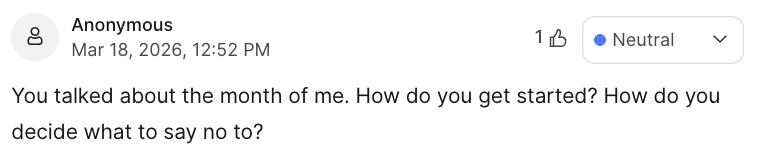
And I realized something in that moment – I’ve never actually broken this down fully here.
So this post is my answer.
I was standing at a lighthouse in Portland. My son was strapped to my chest in a carrier. I could smell the top of his baby head – that intoxicating smell – and feel the salty breeze on my face.
And then it hit me: I was actually present. Mentally, fully, actually there. For the first time in years.
It was about three years after a high-conflict divorce. I had left an abusive marriage. And all I had wanted – through every crisis, every sleepless night, every commute – was to be present with my son. To give him a bath and actually be there for it. Not mentally somewhere else.
Standing at that lighthouse, I asked myself: why don’t I have this every single day? The answer was clear. I had been saying yes to everyone else. Every yes to a commitment, a dinner, a deadline – was a no to myself. To my time. My space. My capacity to be present. So I went home and launched a 30-day experiment. I called it the Month of Me. And it was one of the most transformational things I’ve ever done.
The habits I built during that first Month of Me™? I still use them today — over eight years later. If you’re constantly saying yes to everyone else and no to yourself, this post is for you. I’m going to show you exactly how to create a self care strategy that is simple, customizable and actually sticks.
How to Create a Self Care Strategy: The Month of Me Framework
The Month of Me™ is a 30-day challenge with one simple rule: say yes to what supports your physical and mental health. Say no to everything that doesn’t.
That’s it. The framework does the rest.
Here are the 7 steps I walk through every time – and that I teach in my keynotes and cover in full detail in my book, The Five Overwhelm Culprits™.
The 7 Steps to Create a Self Care Strategy That Works
Step 1: Rate Your Health on a Scale of 1–10
Before you can build a plan, you need an honest starting point. Rate yourself from 1 to 10 across these five areas:
- Nutrition
- Sleep
- Hydration
- Movement (physical exercise)
- Mental health
1 means it sorely needs attention. 10 means you’ve got it handled.
Be honest with yourself – this is just for you. Once you have your scores, identify your bottom three areas. That’s where you focus first. When I did my first Month of Me™, mine were movement, mental health, and nutrition.
Starting with three keeps it manageable. You can always add more later.
Step 2: List Out What’s Not Working in Each Category
For each of your focus areas, get specific about what’s getting in the way. These become your no’s.
For me, movement was suffering because I kept saying yes to late business dinners. If I was out past 10 PM, I wouldn’t wake up early enough to work out. So late dinners became a no. With nutrition, I had no structure. I was commuting 20 hours a week and grabbing whatever I could. That had to change.
When you know what’s not working, you know exactly what to stop tolerating.
Step 3: List Out What’s Worked for You in the Past
Now flip it. For each focus area, think about what has actually worked for you before. These become your yes’s.
For nutrition, I knew the Whole30 reset worked well for me. I’d done it for over 10 years. My brain likes structure and it requires meal prepping in advance – which kept me on track. Big yes.
For movement, I loved yoga. I had a back injury at the time that ruled out Olympic lifting, but yoga was still on the table. I found a 30-day yoga challenge on YouTube. Another yes. You don’t need to reinvent the wheel. You just need to go back to what you already know works.
Step 4: Map Out Your Self-Care Commitments on Your Calendar
A plan that isn’t on the calendar isn’t a plan. It’s a wish.
Once you know your yes’s, schedule them. Block the time. Treat those appointments with yourself the same way you’d treat a meeting with your most important client.
For my Month of Me™, I calendared the Whole30 meal prep, my daily yoga sessions, weekly therapy appointments and meditation classes I wanted to try. All of it went on the calendar before the month started.
Step 5: Identify Your Roadblocks and Set Boundaries Around Them
Once your plan is mapped out, the roadblocks become obvious. Don’t wait for them to surprise you. Plan for them now.
My biggest roadblock was social obligations. Business dinners, girlfriend nights out – they were constant. So I set a firm boundary: no dinners that had me out past 10 PM for 30 days. Not for work. Not for friends.
I made a formal announcement on Facebook: I’m deleting my apps. If you want to hang out, text my phone. I’m doing an experiment.
Was it uncomfortable? A little. Was it worth it? Completely.
Boundaries aren’t about shutting people out. They’re about protecting what you’ve committed to yourself.
Step 6: Try It for 30 Days and See How Your Habits Change
Now you execute. For 30 days, you follow your plan.
Some things are going to work beautifully. Some are going to fall flat. That is completely normal and completely expected. The goal of the 30 days is not perfection. It’s information. You’re running an experiment on yourself. Pay attention to what shifts and what doesn’t.
Step 7: Pivot Back to the Framework and Refine
At the end of 30 days, go back to the beginning. Ask yourself:
- what worked?
- What didn’t?
- What would I try differently?
Then run the framework again with what you learned.
This is how a self care strategy becomes a lifestyle – not a one-time thing. You keep enhancing and pivoting in small ways until you find a health and wellness rhythm that genuinely works for you.
I’ve been running my own version of the Month of Me for over eight years now. The original habits I built during that first 30 days? Still part of my life today.
Ready to Create Your Own Self Care Strategy?
If you’ve been waiting for the right time to prioritize yourself – this is it. You don’t need a perfect plan. You just need to start. Rate your health, identify what’s not working, and give yourself 30 days to try something different.
Knowing how to create a self care strategy is only step one. The real shift happens when you commit to following through – and give yourself permission to actually show up for yourself. You have absolutely nothing to lose.
Build Your Month of Me Plan With My Free AI Companion Tool
Not sure where to start? I built a free AI-powered tool on my website that walks you through the entire Month of Me™ framework – step by step – and helps you create a completely customized 30-day plan based on your specific answers.
It takes just a few minutes and takes all the guesswork out of the process. Because the fastest path to showing up for yourself is having a plan that’s actually built for you – not someone else.
Access the free Month of Me™ AI Companion Tool here.
Go Deeper With the Book
The Month of Me is one piece of a much bigger framework I’ve spent years developing – and there’s an entire chapter dedicated to it in my book.
In The Five Overwhelm Culprits™: Strategies to Save Your Sanity Without Sacrificing Your Success, I go deep on all five culprits – including the Lack of Conditioning culprit that this episode covers. You’ll get the full framework, real stories, and a prescriptive roadmap to stop feeling stuck and start leading with clarity and confidence.
This is the book for the woman who refuses to opt out – but needs a smarter strategy to keep going without burning out.
Launching May 12, 2026. Pre-order your copy now.
CLICK FOR TRANSCRIPT
[00:00:00] You talked about the month of me. How do you get started? How do you decide what to say no to? This is a question I received during a recent private event Q&A and I realize it’s a perfect topic to cover here since I’ve never actually covered the Month of Me Challenge on this channel. So if you’re currently struggling with remaining present or implementing self-care. Things like setting boundaries or if you find yourself struggling that you’re constantly saying yes to everyone else and always saying no to yourself. Then you’re gonna wanna stick around because by the end of today’s episode, you’re gonna have a crazy easy 30 day challenge that will help you decide what’s worth saying yes to and what you need to start saying no to.
If you’re new here my name is Corrie LoGiudice. I’m otherwise known as Corrie Lo, and I’m a professional keynote speaker, facilitator, executive coach, and author who helps leaders transform overwhelm into confident action even in times of [00:01:00] crisis.
So this question came up as part of a keynote audience Q&A, and it’s in response to a specific story that I share in the keynote and is also included in my upcoming book and story actually kicks off with me staring at this lighthouse. I am on a family vacation, it was about three years after a very high conflict divorce.
I had left an abusive marriage and I find myself at the
Portland Lighthouse of all places, staring at the lighthouse. I’m holding my son in a baby carrier. I remember I could smell the top of his baby head. You know that intoxicating baby smell as well as I’m feeling like the salty breeze in my face.
I’m looking at the beautiful flowers surrounding the lighthouse. And I have this light bulb moment where I go, “Oh my G**, I’m actually present.” Like I’m mentally present in the moment, and I had struggled for so long. And all those [00:02:00] years following, my high conflict divorce and all the different crises that I had coming up, that all I ever wanted was to be present, especially with my son.
I vividly remember rushing home from work every day to be able to give my son a bath. I wanted to play with him in the bath and then feeling devastated that instead of focusing on him in the bath, I would be thinking about what project I needed to finish at work or what trauma I had just been through with the relationship.
It was impossible it seemed for me to be able to separate one from the other. I always felt like I was split two. And being at the lighthouse that day and anchoring myself in that moment, it made me realize something that part of me was saying, ” Why don’t I have this every single day?” And when I looked and I started thinking about all the different things that led up to me being at that lighthouse the biggest change was that I actually had time and space to be able to enjoy on my vacation.
I wasn’t working, It was X [00:03:00] amount of days off on a cruise ship. Their internet is terrible so I was disconnected from the world. So it really helped me see very clearly that by saying yes to everybody else in terms of things like commitments and showing up and being there every yes was a no to myself in that I didn’t have this time, space or capacity that I needed to actually feel present.
So when I got back from this trip and I actually decided, like when I was looking at the lighthouse, which is the crazy part. I decided when I got back from the trip that I was gonna try this experiment and I called it the ‘ Month of Me’, and for 30 days I was going to say no to any sort of obligation or commitment that was going to be in direct misalignment with my physical or mental health and wellness.
And I made a very formal announcement on Facebook. I said, “Hey guys, I’m deleting all my apps if you wanna hang out text by phone, but know that I’m doing this experiment.” And the experiment [00:04:00] itself was life changing and I’m going to be sharing it with you today.
So I’d love to know, have you ever had a moment where you felt like you weren’t truly present, that it was upsetting to you? Comment below, I’d love to hear about your experience, know that you are not alone. I give this keynote to so many different audiences around the world, and this is by far one of the most resonant messages that I hear from people on a regular basis.
All right, so let’s break down how to do your own month of me. And in the process of doing it, I’m gonna share with you specific examples of what I did, but the framework is highly customizable to what you need specifically. And I also do have a tool that’s available on my website. We’ll make sure that we link to it in the show notes where utilizing ChatGPT it’ll help you figure out your Month of Me challenge.
So first, super simple. First thing you have to do is you have to rate your health on a scale of 1-10. So when you’re rating your health, you’re gonna rate it on the following things. First is gonna be [00:05:00] nutrition, then sleep, then hydration, then movement, that’s physical exercise, and then lastly, your mental health.
All right, so you’re gonna rate it on a scale of 1 to 10. 1 being sorely needs attention to 10 being, I am awesome at this, I need no help with it, I’m an expert. So from there, the reason why this is important is because this is gonna help you then determine the bottom three max areas to start with.
You could start with more than that, but I know for me, when I had done my initial Month of Me, the top areas were, physical movement. I wasn’t moving at all. I had a 20 hour week commute and it was very, very difficult for me to find the time to actually exercise. The other one that was a challenge for me was my mental health. And then, the third one was my nutrition. Those were the three I was really focusing on.
So the first thing that you’re gonna do once you have this information is you’re gonna list out what’s actually not working for you in each category.
Very simply, these are gonna be the things that you are gonna say no to. So [00:06:00] for me, when I mapped this out, I was like, “Oh, okay well what’s not working for me,” I can’t wake up early in the morning to be able to work out because I keep getting requests for social dinners. Whether it be a business dinner in the evening that runs past 10 o’clock, or my friends want to go out for dinner, so one of the first things I’m gonna say no to is gonna be dinner plans that’ll have me out past 10 o’clock ’cause I know then I won’t wake up to work out.
So you’re gonna list out what’s not working for you. So there was, that wasn’t working for me. In terms of what I was eating, I had absolutely no structure or plan to what I was doing. I was commuting a lot. I didn’t have any downtime, so I was gonna need to come up with solutions to eat whole healthy foods while on the go. So figuring out what’s not working for you is gonna help you with the next step.
Next, you’re gonna list out what’s worked for you in the past for each category. These are gonna be the things that you wanna say yes to. So when you look at my example, one thing that was a big, huge neon sign yes for me was in [00:07:00] the past I had seen a lot of success doing the whole 30 reset.
I’m not gonna dive into it here because this is not a health and nutrition podcast or show. But, that said, it worked very well for me. I’ve been doing it for over 10 years. Works great for the way that my mind likes structure. You have to meal prep in advance. It was a big yes for me, so that was one of the things I knew I was gonna implement for my 30 day plan.
That’s actually one of the reasons it was a 30 day plan. ’cause I knew, hey, while I do this whole 30, let’s test out all this other stuff at the same time. So those are gonna be things that you say yes to.
Other things that had worked well for me in the past were things like yoga, I loved doing yoga. I had also loved doing things like Olympic lifting, but I very recently had an injury, a back injury, which was preventing me from being able to lift.
But yoga was still on the table, so I decided, I found on YouTube or something it was like a 30 day yoga challenge. Awesome, that’s gonna be something I’m gonna say yes to.
So then from there you’re gonna list out what’s next in terms of self-care. What you’re gonna commit to and you start mapping it out on your calendar. So for my Month of Me, and I already [00:08:00] alluded to a few of them, I was gonna do the whole 30 nutritional plan, I was also gonna do the 30 day yoga plan and I also on the calendar was gonna specifically put in appointments for things like working with my therapist as well as meditation classes because those are things that I had yet to try, that I wanted to try, that I knew would directly impact the mental health side. Which are things I needed help with.
Once I that out, then from there it is very easy to see different roadblocks that were gonna pop up, that were gonna prevent these things from happening. So when you think of roadblocks, you’re thinking of things like interruptions for example. So one of my roadblocks was gonna be these dinner plans.
I was constantly being asked to go for business dinners and dinners with my girlfriends. So in order to accommodate this, you have to set boundaries and hold yourself accountable. So I set very firm boundaries that I was like, for 30 days I’m not doing business dinner, I need to take care of myself.
This is part of a temporary, project for me. I will not do a business dinner that’ll have me out past 10 o’clock in the evening, I need to be home by 10. I [00:09:00] also will not be going out with the girlfriends. If you wanna go for brunch on a Sunday, cool. But if you want me to go out on a Friday night, not gonna happen.
I need to be able to wake up early to do my yoga and everything else I had committed to myself. So you set boundaries to, hold yourself accountable. So those are the things you’re gonna say both yes and no to. And then from there, you’re going to try it out for 30 days and see how your habits change.
And truth is, over the 30 days, you’re gonna find some things are gonna work great, some things are gonna be not so great. And then from there, it’s a matter of just pivoting. You go back to the same exact framework that I just talked about. When you think about it’s , very simple. You go back to, what’s working great, what’s not working great? What could I try differently for the next 30 days?
And then you keep enhancing and pivoting and making minor changes until you find a health and wellness solution that works well for you. So I highly encourage it. Try it out for 30 days. Map out your own Month of Me. And see how your habits change. It was transformational for me. I had initially done my [00:10:00] first month of me over eight years ago at this point, and the habits I put in place I still use today.
So to recap, the Month of Me is a very simple 30 day challenge where you say yes to opportunities to care for yourself and no to the roadblocks and challenges surrounding them.
Anything that’s a misalignment for your physical and mental health and wellness is just a no. So you could start your own today by, again, you’re gonna rate your mental and physical health on a scale of 1-10. 10 being you’re a rockstar at it, and 1 or 0 being you need a lot of work on it.
And then from there you’re gonna list out what’s not working when it comes to those areas. What’s worked before? And then from there, it makes it very easy what to say yes to and what to say no to, as well as to figure out what roadblocks that might prevent you from getting there so that you can accommodate them via things like boundaries to hold yourself accountable or to hold other people accountable.
And then it’s as simple as trying it for 30 days and seeing what happens. You have absolutely nothing to lose. So hopefully you found my sharing my [00:11:00] Month of Me Challenge helpful today. If you have a follow up question or any other question related to physical and mental health and wellness.
Anything related to the Lack of Conditioning Culprit, which is what this episode covered. Feel free to go ahead, drop them in the comments below. You could also send me a DM on LinkedIn. Send my team an email. We just may feature your question on a future episode.
And as I mentioned, I cover the Month of Me in detail. There’s a whole chapter in my book on it with even more strategies. So grab my book, The Five Overwhelm Culprit™ Strategies to Save Your Sanity Without Sacrificing Your Success. It’s available on May 12th, and you can pre-order it right now in the show notes.
You can also learn even more ways to work with me whether that be the digital tools and resources, like I mentioned before with the Month of Me AI companion. There’s also information on how to work with me one-on-one via coaching, or even with teams and organizations via keynotes and workshops. You can find all those details in the notes below. Thank you so much for being here, and I can’t [00:12:00] wait to see you on the next episode.
I’ll see you next time.
Thanks for checking out the next step with Corrie Lo. If this episode resonated with you, share it with a friend, subscribe and leave a review. Together we’ll transform overwhelm into action and we’ll keep taking the next step towards competent leadership. See you next time.