


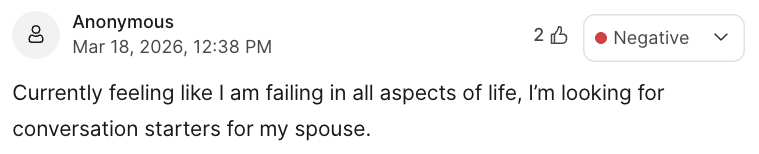
This came in as a statement – not even a question – during a recent private event Q&A. And honestly? I felt seen just reading it. I’ve been there myself. If you’re feeling like a failure in life right now, this post is for you. By the end, you’ll have simple, practical scripts to spark a conversation with the people around you. Because sometimes what we need isn’t a solution – it’s support. And knowing how to ask for it makes all the difference.
Feeling Like a Failure in Life? You’re Probably Not Failing
I’ve felt this way a few times in my life. And every single time, it was tied to a major life change involving parenting.
The first was when I left an abusive marriage and became a single mom to an infant.
The second was after my second child was born. I struggled with the shift from one kid to two.
The third was when my daughter started a new school program with a 2:00 PM pickup – eliminating over 20 hours of work availability a month, just like that.
In all three situations, the truth was the same. I wasn’t failing. I was handling a major life change – alone – that most people navigate with two or more people sharing the load.
When feeling like a failure in life what to do isn’t always about fixing yourself. Sometimes it’s about recognizing you need more support – and knowing how to ask for it.
In my Overwhelm Culprits™ framework, this falls under the Lack of Community culprit. The fix isn’t working harder. It’s looping in your support team.
What to Do When Feeling Like a Failure in Life: A Step-by-Step Script
The goal isn’t to have a heavy, scary conversation. The goal is to have a safe one. Here’s how to do it.
Step 1: Start With a Gentle Opener
Don’t lead with “we need to talk.” That puts people on the defensive immediately. Instead, lower the stakes from the start.
Try one of these:
“Hey, can I share something that’s been on my mind lately?”
“I’ve been feeling a little off recently. Do you have a few minutes to talk things through?”
“I don’t need you to fix anything. I’d just love to talk something through with you.”
“Can we have a quick check-in tonight? Nothing major — I just want to feel more connected.”
These work because they remove blame and urgency. They open the door without making it feel like a crisis.
Step 2: Name the Feeling Without Self-Attack
Saying “I feel like I’m failing at everything” is heavy and vague. It’s hard for someone else to respond to. And it can spiral fast.
Reframe it into something more processable:
“Lately I’ve been feeling like I’m not showing up the way I want to in a few areas of my life.”
“I’ve been feeling really stretched thin, and it’s starting to get to me.”
“I’ve been really hard on myself lately, and I don’t think I’ve shared that with you.”
“I feel like I’m carrying a lot mentally right now and I don’t fully know how to sort it out.”
These keep ownership with you. They express what’s real without making your support person feel helpless or blamed.
Step 3: Get Clear on What You Need
This is the step most people skip. And it’s the most important one. Without it, the other person defaults to fixing, minimizing, or shutting the conversation down. None of which helps.
Direct them with prompts like:
“Can you just listen for a minute before we try to solve anything?”
“I think I mostly just need reassurance right now. Is that okay?”
“I’d love your perspective – but I’m not ready for solutions just yet.”
“Can we think through this together instead of trying to fix it right away?”
Step 4: Invite Partnership
This is where the conversation shifts from “I’m failing” to “we’re a team.” That shift is everything.
“Can we look at what’s been feeling overwhelming together?”
“I don’t want to feel like I’m doing this alone. Can we figure this out as a team?”
“What have you noticed about me lately? I’m curious how I’m showing up from your perspective.”
“Is there anything you’ve been feeling too that we haven’t talked about?”
This is where real connection happens. And connection is what you’re actually after.
Step 5: Make It Specific
“I feel like I’m failing at everything” is overwhelming – for you and for them. It’s undefined. Break it down. “What I’m struggling with most right now is ___” (work, parenting, energy, time — fill in the blank).
“The part that feels hardest lately is ___”
“If I’m honest, what’s been weighing on me most is ___”
“One example from this week that really stuck with me was ___”
Specificity gives your support person something real to hold onto. It moves the conversation forward.
Step 6: Close the Loop
This is what nobody teaches – and it matters. Don’t let the conversation end on a heavy note.
“Thanks for listening. I already feel better just saying that out loud.”
“I don’t expect us to solve this right now. I’m just really glad we talked.”
“Can we keep checking in like this? It helps more than I realized.”
“I appreciate you being in this with me.”
Feeling Like a Failure in Life? Here’s What It’s Really Telling You
When you’re feeling like a failure in life, what to do isn’t always obvious. But here’s what I know for sure.
Feeling like you’re failing in every area is rarely actually about failure. It’s usually a sign that something in your current reality isn’t being supported by your current strategy.
The fastest way through it is not to push harder alone. It’s to loop in your support team and stop carrying it by yourself.
You were not designed to do life solo. Neither was I.
Find Out Which Overwhelm Culprit Is Holding You Back
Take the free Overwhelm Culprit Quiz™ — it only takes three minutes and will point you straight to your next step.
If you’ve been feeling like you’re failing in every area, there’s a reason. And it’s usually one of five specific culprits quietly running the show behind the scenes.
I created the Overwhelm Culprit Quiz specifically for high-performers – especially women – who are tired of spinning their wheels and ready to get clear on what’s actually in the way. It’s only six questions. It takes about three minutes. And it will tell you exactly which culprit is at the root of your overwhelm – plus your most powerful next step to address it. Take the free Overwhelm Culprit Quiz here.
Go Deeper With the Book
In my book The Five Overwhelm Culprits™, I go deep on all five culprits – including the Lack of Community culprit at the heart of this episode. You’ll get the full framework, real stories from my own life, and a practical, prescriptive roadmap to stop feeling stuck and start leading confidently. At work, at home, and everywhere in between.
This is the book I wish I’d had when I was a single mom standing on my parents’ doorstep with a baby and a suitcase, wondering where to even start. It’s for the woman who refuses to opt out — but needs a better strategy to keep going. The Five Overwhelm Culprits™ launches May 12, 2026 and is available for pre-order now. Grab your copy here.
CLICK FOR TRANSCRIPT
[00:00:00] “Currently feeling like I’m failing in all aspects of my life. I’m looking for conversation starters from my spouse.” This is not so much a question but a statement that I received during a recent private event Q&A and I don’t know about you, but I feel seen even just reading it, I’ve been there myself.
So if that resonates, stick around because by the end of this episode, you’ll have some super simple scripts that you could use to spark a conversation with the people around you to support you on the level that you need. This is especially for when you’re feeling like you’re failing and you know you need the support, but you are unsure on how to ask for it.
Speaker: If you’re new here, my name is Corrie LoGiudice, otherwise known as Corrie Lo, and I am a professional keynote speaker, facilitator, executive coach and author who helps leaders transform overwhelm into confident action even in times of crisis.
There’s been a few times where I can [00:01:00] confidently say that I felt like I was failing in my life and not surprisingly, they were all centered around major life changes involving parenting.
The first one was when I left an abusive marriage and became a single mom of an infant.
The next one was when I had recently had my second child and was having difficulty navigating the change between one to two.
And the third one was when said Second child started a different school program with a 2:00 PM school pickup. Effectively eliminating over 20 hours of my work availability a month.
And in all three situations when you break it down, truth was I wasn’t failing, I was handling a major life change by myself that usually two or more people handle together.
So during this timeframe when this would happen, my Overwhelm Culprit™ was Lack of Community, and I needed more support to get my head above water again. So during my divorce, I [00:02:00] needed to have conversations with my family to step in and ask for help. After my second child, I needed to have conversations with my new husband,
and the hardest part about all this was not that I felt like a burden for asking for help, it was that I needed to feel safe enough to be seen without it turning into a heavier defensive conversation. I’d love to know, have you ever felt this way? If so , drop me a hand, raise emoji in the comments.
So if you are feeling like you’re failing in every area of your life, don’t start with a heavy conversation. The goal is we wanna start with a safe one. We wanna kick this off with a gentle opener. We wanna make it low pressure, low defensiveness from the person we’re asking for support with.
These gentle openers help enter the conversation without making it feel like it’s some big, scary we need to talk conversation. So some options could be things like, “Hey, can I share something that’s been on my mind lately,” or. “I’ve been feeling a little off recently. Do you have some time to maybe talk things through [00:03:00] for a couple minutes?” Or possibly
“I don’t need you to fix anything, but I’d really love to talk something through with you if you’ve got some time right now” or better yet, “can we have a quick check-in tonight? Nothing bad, nothing major. I just wanna feel a little more connected.” Now. There’s a few reasons why these work. First is they lower the stakes and remove fear of being blamed.
That, or needing to solve a problem immediately. So it’s going to open up the door in a very safe manner for you to actually bring up what’s on your mind.
Next up, we wanna be able to name the feelings. And we wanna be able to do this without any sort of self attack. So most people will say,
“I feel like I’m failing at everything.”
And that can come out really heavy, it sounds kind of vague and it’s hard to respond to. Put yourself in the other person’s shoes.
It’s never fun to be on the other end of somebody’s trauma dumping. So ideally we wanna reframe this into something that’s more processable. Some ideas could be things like, “lately I’ve been feeling like I’m [00:04:00] not showing up the way I want to in a few areas of my life,” or “I’ve been feeling stretched really thin and it’s really starting to get to me.”
Or another option would be, ” I’ve been really hard on myself recently, and I don’t think that I’ve shared that with you.” Or even “I feel like I’m carrying a lot mentally right now and I don’t fully know how to sort it out.” The nice part about these is it helps you keep ownership. You know that it’s something that you are going through, but it avoids any kind of spiraling language that’s going to make your partner or whoever it is you’re looking for support from feel helpless.
From there the next goal is we wanna create clarity around what it is that we need. So this is where most people don’t guide their audience, and that’s the missing piece. So without this, the spouse or whoever you’re looking for support from will default to doing things like fixing the situation or minimizing it or shutting it down, which we wanna avoid.
You wanna give them prompts that direct the kind of support that you want. So for example, “can you just listen for a minute before we try to solve [00:05:00] anything” or, “I think I mostly just need reassurance right now. Is that something that you’d be open to?” Or, “I’d love your perspective, but just being honest. I really don’t need any solutions just yet.” Or ” can we think through this together instead of trying to fix it right away?”
From there, then it’s the right time to start to invite partnership. We wanna invite partnership instead of this conversation feeling like you’re isolating yourself from others.
This shifts from, ‘ I’m failing’ to, ‘ we’re a team’. Some prompts you could use, include. “Can we look at what’s been feeling overwhelming together?” Or ” I don’t wanna feel like I’m doing this alone. Is this something that we could figure out as a team?” Or “what have you noticed about me lately? I’m curious to know how I’m showing up from your perspective,” or even “is there anything that you’ve been feeling too that we haven’t talked about?” And this is where connection happens, which is ultimately what you want.
So from there, you need to connect everything you’re talking about to specific areas, because then otherwise it’s, as you can tell, it stays kind of abstract. So saying
“I feel like I’m [00:06:00] failing at everything.”
That’s overwhelming to your partner, your support person because it’s undefined. So help them break it down.
Some prompts that you could explore would be things like, “I think I’m struggling mostly with right now is.” Maybe it’s work, parenting, energy, time, fill in the blank. “The part that feels the hardest lately is” specifically what it is that you feels the hardest, or “if I’m honest, the thing that’s been weighing on me the most is” fill in the blank “one example from this week that stuck with me was ” fill in the blank.
So from there, the conversation will naturally evolve. You’re gonna have some really great connection. You’re gonna feel seen, you’re gonna feel heard and all that’s left from there is closing the loop so that the conversation doesn’t end on heavy note.
This is huge and this is what no one teaches.
Some prompts for this include. “Thanks for listening to me. I already feel so much better just by saying that out loud”, or “I don’t expect us to solve this right now, but I am really, really glad that we talked. Thank you for taking the time.”
Or “can we keep checking in like this? It helps me more than [00:07:00] I realized.” And lastly, ” I appreciate you being in this with me.” When you feel like you’re failing in all areas, it’s usually not a failure. It’s a sign that something in your current reality isn’t being supported by your current strategy.
One of the easiest ways to navigate through this is by looping in your support team so that you’re not going through it alone.
So to recap everything we talked about, you want to frame a psychologically safe conversation about you feeling overwhelmed by all the things and feeling like a failure about all the things by doing the following. First, you’re using a very gentle opener. You wanna make sure that they’re not defensive coming into the conversation.
From there, you’re naming the feeling from after you are creating clarity around your specific needs. Then we are inviting partnership and making specific asks on what it is that you need support with. And then from there, simply closing the loop.
So hopefully you found my sharing this today helpful. If you have a question that you’d like me to answer, please feel free. Go ahead, drop it in the comments. We just may feature it on a future episode. [00:08:00] And as I mentioned, I cover this question in detail with even more strategies for the
Lack of Community Culprit
in my new book The Five Overwhelm Culprits™, which is launching on May 12th.
It’s currently available for pre-order in the show notes and you could also learn more ways to work with me whether that be one-on-one through things like coaching or within your organization through speaking and workshops in the show notes as well. So thank you so much for being here, and I look forward to seeing you on the next episode.
Thanks for checking out the next step with Corrie Lo If this episode resonated with you, share it with a friend, subscribe and leave a review. Together we’ll transform overwhelm into action and we’ll keep taking the next step towards competent leadership. See you next time.